
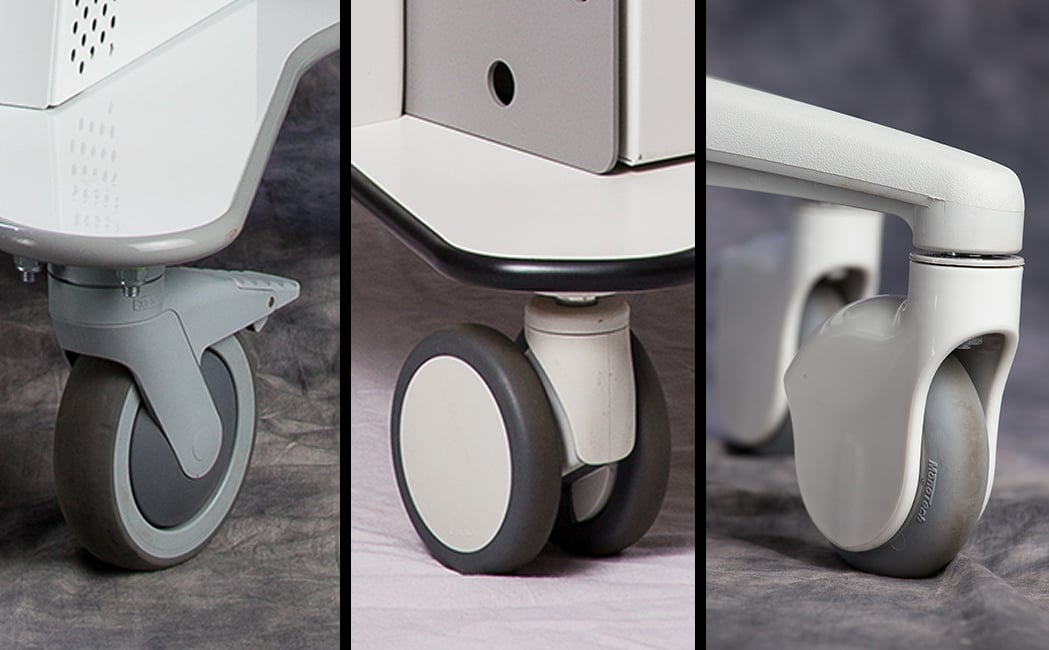
For years, selecting casters for medical carts followed a straightforward formula: equip two wheels with locks and leave two without. However, the introduction of rigorous caster testing protocols in the IEC 60601-1 3rd edition has prompted manufacturers and designers to completely rethink their approach to caster selection and configuration.
IEC 60601 Testing Requirements
The IEC 60601-1 testing requirements simulate real-world scenarios where medical carts might be positioned on inclined surfaces, such as ramped hallways or sloped floors. Illustrations of these tests can be found in our Infographic: IEC 60601-1 for Medical Carts.
During caster testing, a medical cart with braking mechanisms must be positioned on a hard, flat surface inclined at:
- Five degrees for transport position testing
- Ten degrees for non-transport position testing
The most challenging aspect of caster testing is the requirement that carts be evaluated in their worst-case position or how they are most likely to fail. The criteria is straightforward: if the cart slides more than 50mm (around 2 inches) during caster testing, it fails to meet safety standards.
Two-Caster Systems Often Fail Caster Testing
When a medical cart with only two locking casters is positioned on an incline with locked wheels facing upward, the unlocked wheels at the lower end have no resistance to prevent sliding. The cart's weight creates a pull that two locked casters alone cannot withstand. During caster testing, two-caster systems frequently exceed the 50mm movement threshold and fail the test.
Most medical carts are meant for maneuverability and need to be designed for the range of positions in which they may be placed. To address this, many designers have been favoring four locking casters, but there are other options.
 Four Locking Casters
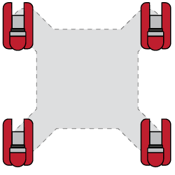
Many manufacturers now default to four locking casters as their standard configuration. This approach provides braking force at all corners, regardless of cart positioning on an incline. During caster testing, carts with four locking casters demonstrate superior stability across all worst-case scenarios, offering the most reliable path to passing caster testing requirements.
 Diagonal Locking Configuration
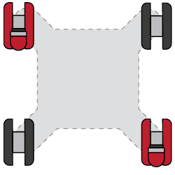
Positioning two locking casters diagonally ensures that during caster testing, at least one locked caster will provide resistance regardless of orientation. This approach maintains cost advantages while improving caster testing performance compared to traditional adjacent-wheel locking arrangements.
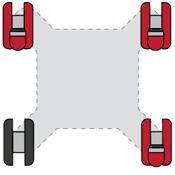 Three Locking Casters
A three-locking-caster configuration guarantees that both front and rear have braking force, proving beneficial during caster testing on inclines. This design often provides sufficient stability to pass caster testing requirements without the full expense of four locking mechanisms.
Caster Testing Considerations
When developing or selecting medical carts for caster testing, consider:
-
Weight Distribution: Equipment loads shift the center of gravity during caster testing. Carts designed for heavy monitors or imaging equipment need especially thorough testing.
-
Wheel Material and Size: The type of material and wheel size affect grip during caster testing. Larger wheels made from quality materials typically perform better on slopes.
-
Lock Mechanism Quality: The locking mechanism's strength and reliability can be just as important as how many casters lock.
-
Maneuverability Requirements: The best caster setup meets safety standards while still allowing easy movement through tight hospital spaces.
If you have questions about caster testing requirements for your medical cart or need help choosing the right caster configuration, we're here to help. Expert guidance can make the compliance process easier and ensure your products meet all safety standards. If you have questions about your product and 60601 testing requirements, please contact us! We’ll be happy to help.