
Bringing a medical device to market can be extremely complicated; between regulatory requirements and clinical validation, the path from an idea to approved product can take awhile.
Understanding the medical device product development timeline helps manufacturers, engineers, and healthcare stakeholders align expectations, allocate resources, and avoid costly mistakes.
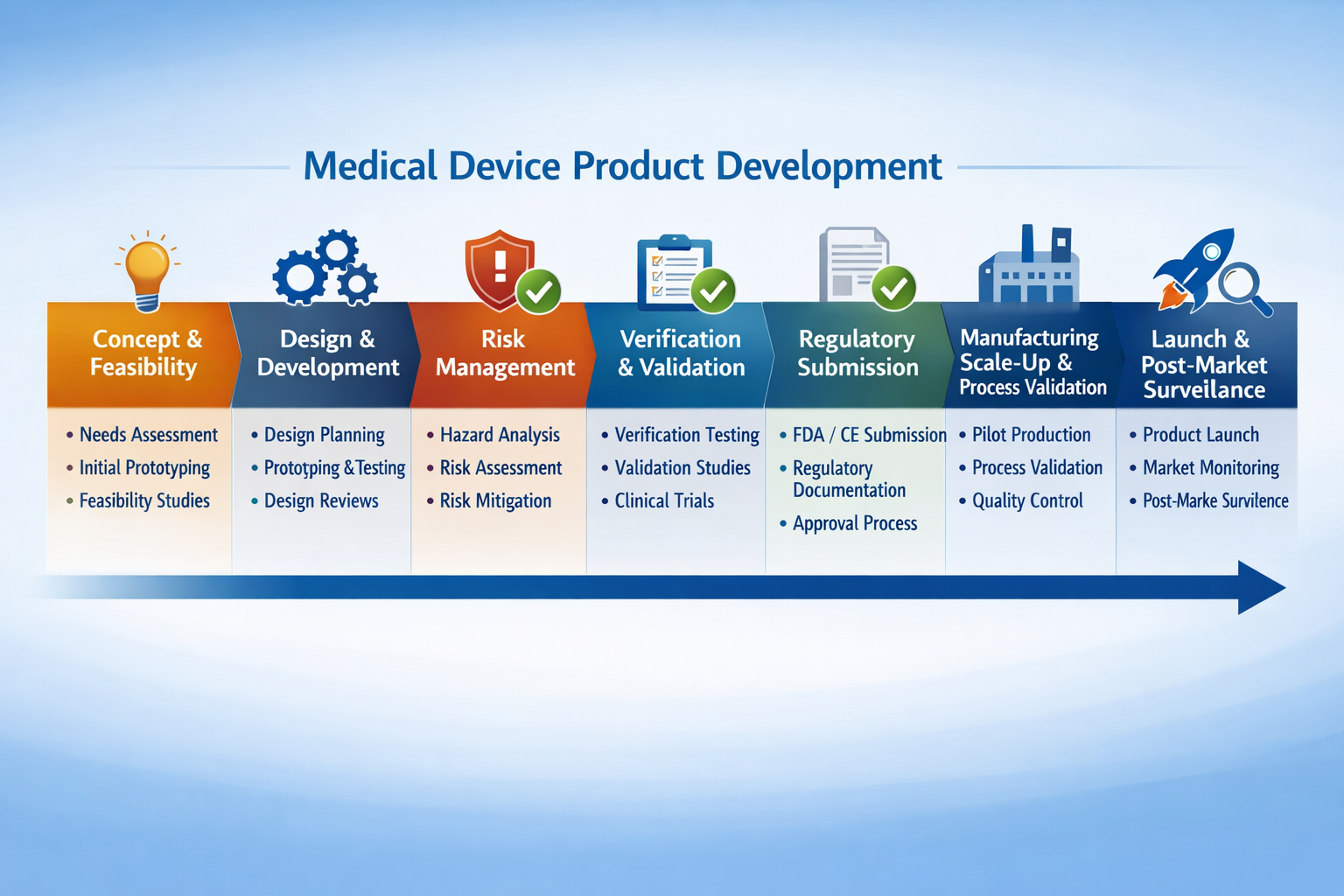
Here's a breakdown of the key phases.
Phase 1: Concept and Feasibility
The concept phase is about translating an idea into something real.
During this step, teams define the device's use, target population, and performance requirements. Market research, competitive analysis, and clinician interviews can help validate the need for the product and that the proposed solution is worth pursuing. An assessment of regulatory requirements also happens in this phase, since that determination shapes future steps.
The concept and feasibility phase ends with a decision: is this concept technically achievable, commercially viable, and regulatorily navigable? If yes, development moves forward.
Phase 2: Design and Development
With feasibility confirmed, the formal design process begins. This is the heart of medical device product development, where concepts become engineering specifications and specifications become prototypes.
Teams develop the functional, performance, and safety requirements the device must meet and turn them into drawings, material specifications, software architecture, and manufacturing processes. Human factors engineering also take place during this phase - because building and testing prototypes early helps engineers catch design flaws before they turn into costly fixes.
This phase also establishes the design history file (DHF), which is the living document that captures every design decision, test result, and change throughout the development process.
Phase 3: Risk Management
Risk management runs in parallel with the entire medical device product development process. Under ISO 14971, manufacturers are required to identify, evaluate, and mitigate risks associated with their device throughout its lifecycle.
Failure mode and effects analysis (FMEA), hazard analysis, and risk-benefit assessments are core tools here. The goal is to reduce risks to acceptable levels, since removing all risks is impossible, and document the reasoning behind those decisions. Regulators scrutinize risk management files closely, and gaps in this documentation are a common cause of submission delays.
Phase 4: Verification and Validation
Verification answers the question: did we build the device right? Validation answers: did we build the right device?
Verification testing confirms that the device performs as specified under defined conditions. This includes tests like bench testing, environmental stress testing, electrical safety testing, and biocompatibility evaluation.
Validation goes further, testing the device in conditions that simulate real-world use. This includes hands-on testing with real end users, real-world use simulations, and clinical evaluation. Devices with software require additional testing to confirm that the software performs as intended.
Together, verification and validation generate evidence that regulators require to confirm a device is safe and effective.
Phase 5: Regulatory Submission
With a technical file completed, manufacturers submit to the relevant regulatory body (the FDA in the United States, a Notified Body for CE marking in Europe, or both for global market access). The submission typically includes the device description, intended use, risk management file, testing data, labeling, and manufacturing information.
Review timelines vary significantly by submission type and regulatory body. FDA 510(k) reviews average several months, while PMA applications for higher-risk devices can take a year or more.
Phase 6: Manufacturing Scale-Up and Process Validation
Scaling from prototype to production-ready device requires validating that manufacturing processes consistently produce devices that meet specifications.
Process validation, equipment qualification, supplier qualification, and quality management system audits all happen here. For devices subject to FDA oversight, compliance with 21 CFR Part 820 (Quality System Regulation) or the newer alignment with ISO 13485 is mandatory.
This phase is frequently underestimated in medical device product development timelines. Discovering a manufacturing process issue after clearance is a scenario worth investing heavily in to avoid.
Phase 7: Launch and Post-Market Surveillance
Launch is not the end of medical device product development. Regulatory frameworks in both the US and EU require manufacturers to actively monitor device performance in the field through post-market surveillance (PMS) programs.
Complaint handling, adverse event reporting, periodic safety update reports, and real-world clinical data collection are all part of post-market obligations. This data feeds back into risk management files and can trigger design changes, labeling updates, or recalls.
How Long Does It Take?
A simple medical device might reach market in 18 to 24 months whereas a unique, high-risk device can take five to ten years. Most devices fall somewhere in between this timeframe.
What usually extends timelines is underestimating the requirements in each phase. Teams that invest in getting these phases right the first time almost always reach market faster than those who rush and have to backtrack.
Need to develop a device-integrated cart or system solution? Download and read our Medical Cart Project Scoping Document to see how we can help you develop and bring to market the medical cart you need!