
The International Electrotechnical Commission developed IEC 60601-1 to establish a clear standard for the safety and reliability of medical equipment. These tests are designed to simulate the physical demands, electrical hazards, and daily wear that medical equipment faces in healthcare environments. Passing these tests is more than just meeting a requirement; it's confirmation that the cart is built to withstand the demanding, day-to-day conditions of a healthcare environment.
Motion and Stability: The Foundation of Cart Safety
A major portion of the certification process asks a single, deceptively simple question: Will this cart stay upright?
The answer requires far more than a quick test in a warehouse. Evaluators examine stability across multiple conditions, including when the cart is being moved, when it's parked and locked, and the usual day-to-day activities the cart would encounter.
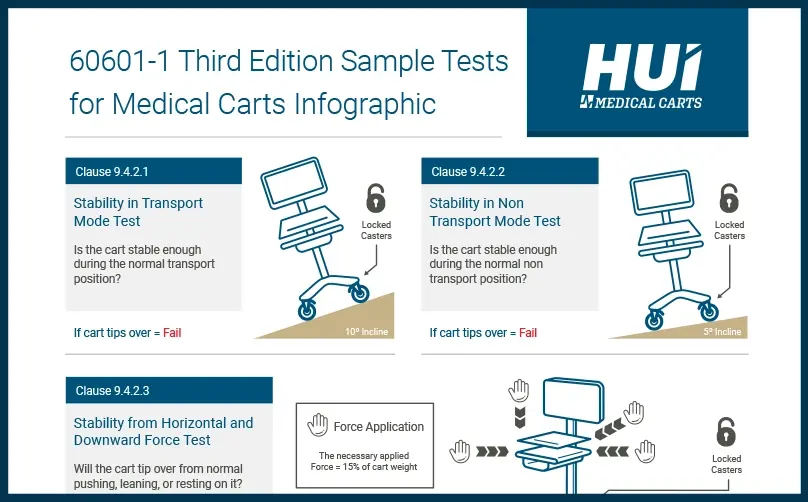
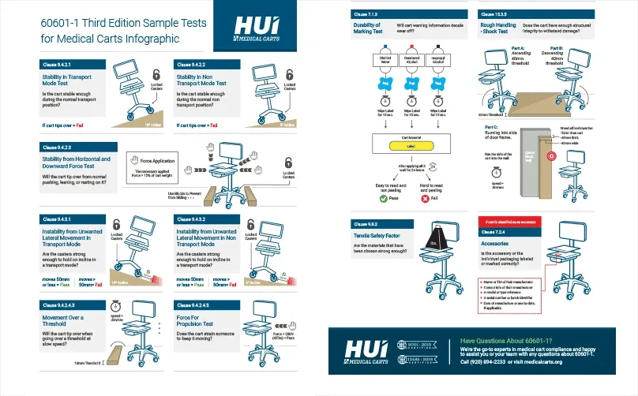
HUI developed the IEC 60601-1 3rd Edition Cheat Sheet to help better understand how the different 60601 clauses and sample tests apply to medical carts. To help simplify things, this infographic narrows these clauses and 60601 sample tests down to the basics.

Key Testing Categories at a Glance
Stability
-
Stability during transport and stationary use across multiple incline scenarios like ramps or uneven surfaces.
Instability
-
Resistance to tipping over during events like sudden stops or uneven load distribution.
Threshold tolerance
-
Threshold crossing tested at realistic operating speeds through corridors, entry/exit ways, and doorway clearance.
Propulsion
-
Propulsion force limits are measured to protect healthcare workers from ergonomic strain.
Marking Durability
-
Durability of safety markings and warning labels under cleaning protocols
Handling
-
Structural resilience under simulated rough-handling conditions like drop testing or repeated loading or unloading.
Tensile Safety
- Tensile strength of attachment points, restraints, and load-bearing components tested to verify safe retention of equipment and accessories.
Accessories
- Compatibility and safety of add-on accessories tested under standard use conditions to ensure secure attachment and no compromise to overall device stability.
What Certification Really Means
For teams evaluating medical cart vendors, 60601-1 compliance is evidence that a product has been tested by a third party and passed. Each clause in the standard represents a failure mode that someone, somewhere, identified as a genuine risk to patients or workers and decided to test for systematically.
The next time a nurse wheels a cart down a corridor without a second thought, that ease of motion is the point. Certification exists precisely so that nobody has to think about it.
If you need HUI’s help designing and manufacturing custom medical carts to 60601 standards, please contact us today!