

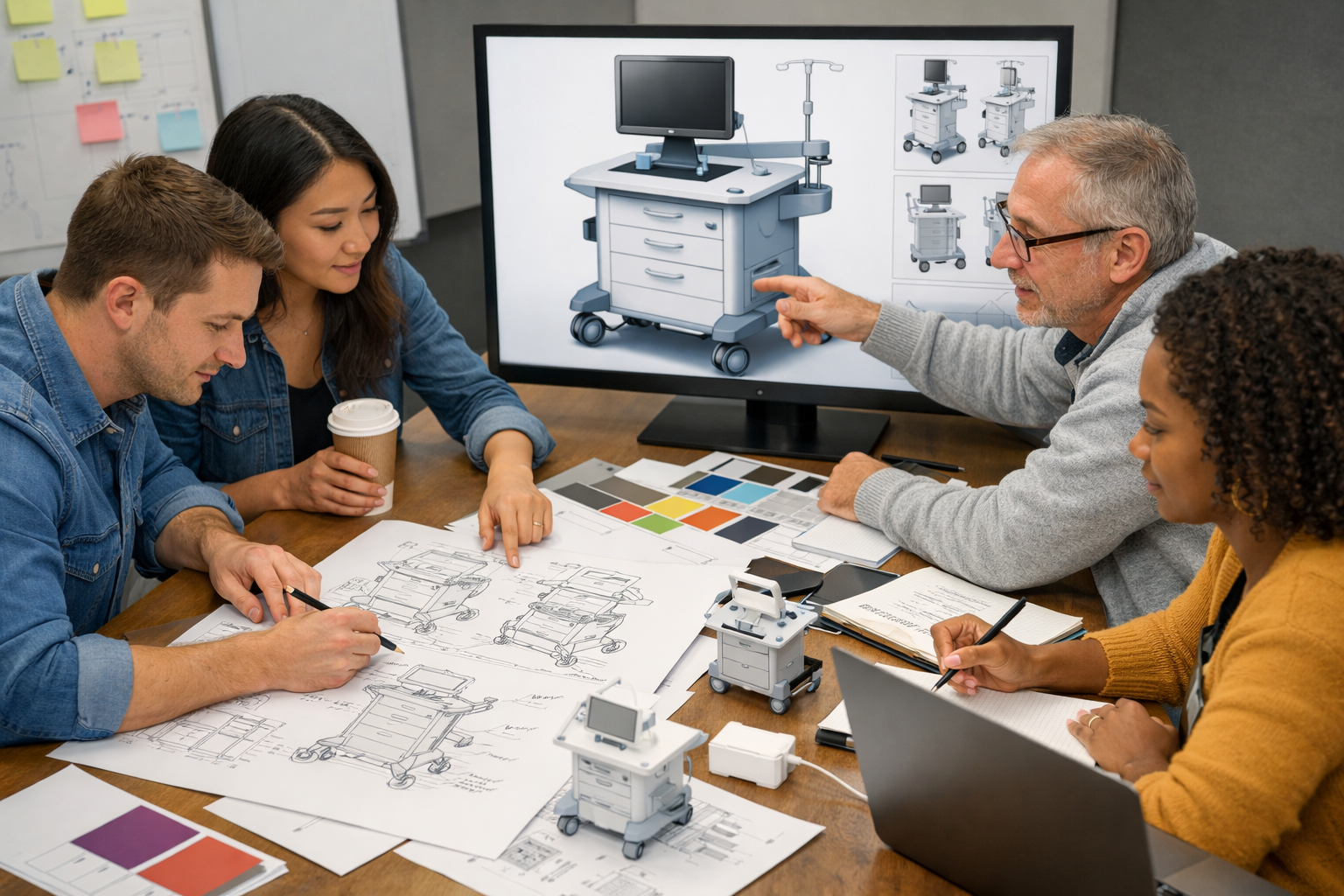
In MedTech, teams often treat the cart, the mobility platform, and the physical support structure around the device as something to think through later. Not out of neglect, but later because attention naturally goes to what feels most urgent: software, electrical architecture, and regulatory planning.
On paper, that natural prioritization makes sense; the device matters, the software is critical, and the electrical system needs to be right. With regulatory work already being a heavy lift, the platform drops down the list.
For a while, that workflow holds up.
Then it doesn’t.
Real World Workflow
By the time questions about power distribution, cable routing, monitor placement, ergonomics, service access, cleaning strategy, thermal behavior, and real-world workflow all start colliding, the cart is no longer just a cart. Whether anyone meant it to be or not, it has become part of the product system itself.
Most teams do have a rough idea of the cart from the beginning. There is usually some mental picture of how the system will stand, move, and support the device. What tends to be overlooked is that those early sketches already carry assumptions about ergonomics, stability, access, airflow, and how people will actually interact with the system day to day.
Consequences
If those assumptions are not examined with the same seriousness as software or electrical architecture, they tend to resurface later, usually at a cost, and when they surface late in development, the consequences are familiar:
-
awkward usability
-
redesign cycles
-
added test complexity
-
assembly challenges
-
launch friction
The physical support system around a product is often treated like packaging. In reality, it shapes how the product is used, moved, powered, serviced, cleaned, and trusted in the field. The more complex the device becomes, the less realistic it is to treat the platform as a downstream detail.
This problem starts earlier than many teams expect. Think about the moment when a product first begins to take shape, often literally on the back of a napkin. A founder, a few engineers, maybe an operator, are sketching where the core device sits and what it roughly looks like.
In most cases, those engineers are not industrial designers. They are mechanical, electrical, or software engineers drawing from what they have seen before. That is not a failure. It is normal. But that same moment is exactly when someone needs to be thinking about mobility, ergonomics, cart architecture, and the realities of building a mobile workstation that can survive real clinical environments.
Without that perspective early on, the platform tends to inherit decisions rather than shape them. This is becoming even more pronounced in the AI era. This is why I decided to write an ebook about The Hidden System Around the Device.
AI Era
AI-enabled systems, connected devices, robotics, advanced imaging platforms, and modular point-of-care solutions are all increasing the number of things a full system has to support. Much of the AI conversation focuses on algorithms, models, and software pipelines but there is always hardware carrying that intelligence. There is always a physical system responsible for making those tools usable in practice.
Displays still have to be visible in actual rooms. Hardware still has to move predictably and feel stable. Controls still have to be reachable. Service and upgrades still have to be practical. Even when the intelligence lives in software, the consequences show up physically.
Platform thinking cannot wait for the software to be finished or the electronics to be fully defined. Even if volumes, weights, and configurations are still evolving, the platform needs to be part of the conversation from the beginning.
Many teams still think of the cart as a mechanical wrapper; something that can be designed once the core device is mature, adjusted around it, and finalized later. In practice, that assumption rarely holds.
The moment a product begins to include multiple accessories, displays, batteries, computing hardware, foot pedals, peripherals, or workflow-specific attachments, the platform starts shaping the experience. These inclusions affect how stable the system feels, how confidently it moves, how cables are managed, and how components are accessed for service. At that point the cart is no longer passive. It is influencing workflow, usability, and trust.
 "These inclusions affect what users can reach, what they can see, how stable the system feels, how confidently it moves, how cables are managed, and how components are accessed for service.
At that point, the cart is no longer passive. It is influencing workflow, usability, and trust."
This is often the point where teams realize something feels “off,” even if they can’t yet name it.
What looked like a late mechanical task becomes a cross-functional system problem. Mechanical, electrical, human factors, manufacturing, quality, and service all suddenly have a stake in decisions that were treated as secondary earlier. When those decisions surface late, they are expensive to unwind.
By the time these issues surface during verification or service planning, the platform is no longer easy to change.
Cable routing affects electrical layout. Monitor placement affects posture and visibility. Service access affects maintenance strategy and test planning. Stability and center of gravity affect transport and safety. Once the platform is carrying that much responsibility, it is no longer neutral. It actively shapes how well the product works in the real world.
As devices become more intelligent and more connected, the surrounding physical environment becomes less forgiving. Advanced systems demand clearer visibility, better interaction design, more disciplined power and cable management, and more intentional access for upgrades and service. The same pressures show up in robotics, medical imaging systems, and workflow-heavy clinical platforms.
As internal logic grows more complex, the physical system supporting it has less room for error. If the platform introduces clutter, awkward posture, blocked access, unstable movement, confusing setup, or poor visibility, it can quietly undermine the value of the technology it supports.
That is why the “we’ll figure out the cart later” mindset keeps breaking down.
Compliance
There is also a regulatory dimension that tends to arrive earlier than expected. Platform decisions can influence electrical layout, cable control, access, maintenance pathways, cleaning strategy, transport robustness, and setup consistency. All of those intersect with compliance thinking. They affect how parts of the system are tested, validated, and defended later. In regulated products, that matters more than teams often anticipate.
The specifics vary from product to product. No two systems are identical. But the pattern shows up again and again: when platform decisions are delayed, the burden grows. When they are addressed earlier, products tend to become cleaner, more usable, and easier to move toward launch.
That is why mobility, ergonomics, and platform architecture can no longer be treated as late packaging decisions. In many systems, they are already part of the product long before teams are ready to acknowledge it.