
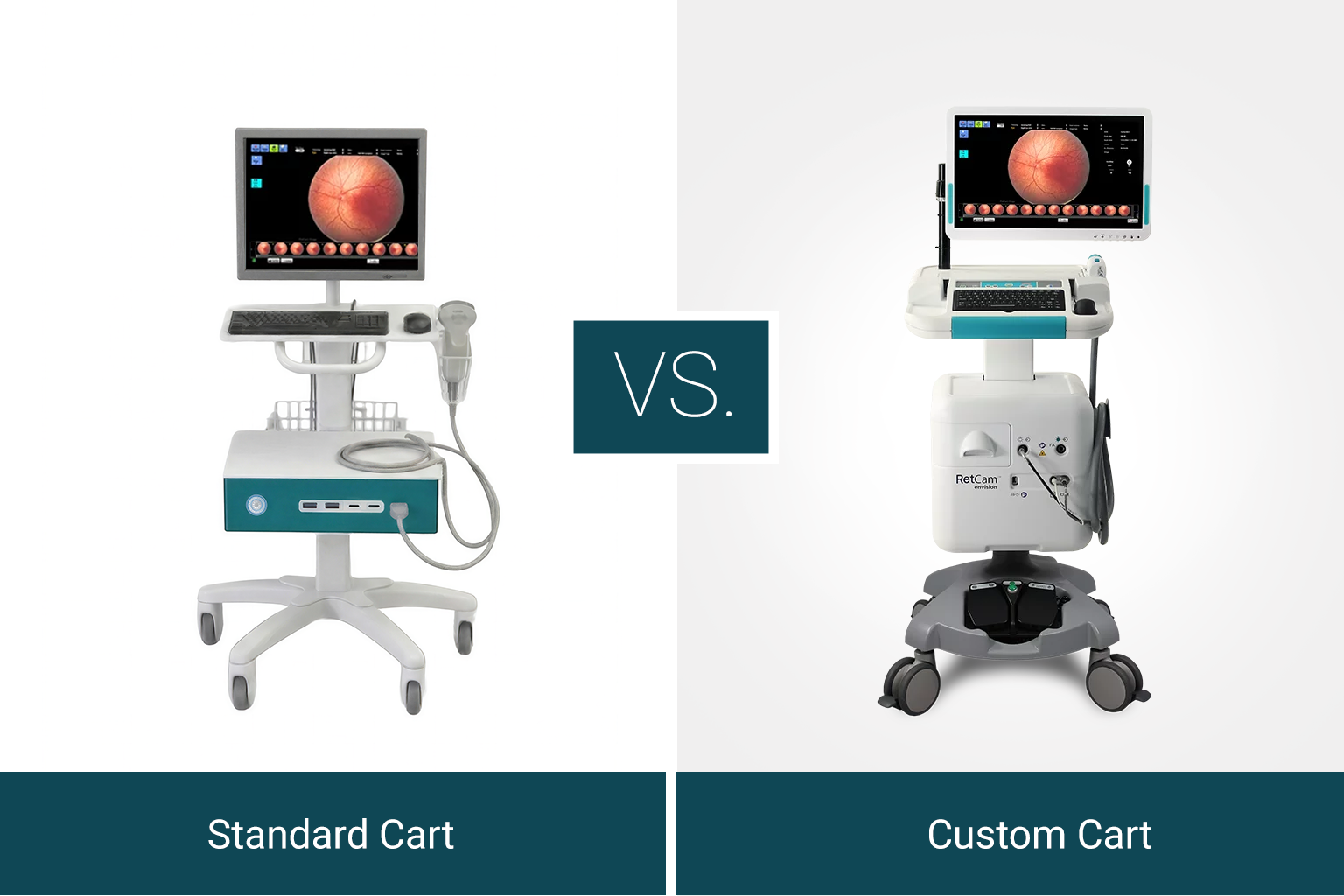
Not every product needs a fully custom platform. Not every team benefits from chasing customization just because it sounds like the more careful or flexible choice. The real goal isn’t to customize everything. It’s to be clear about where customization actually helps and where staying standard quietly makes things faster, cleaner, and easier to scale without introducing new issues later on.
That disconnect is usually where the conversation starts to go sideways and why I decided to write a much more elaborate piece on the subject "The Hidden System Around the Device."
Standard vs Custom
“Standard cart or custom cart?” sounds like the right question, and it’s the one teams almost always reach for first. But early on, especially in medical cart development, it’s usually the wrong place to focus. It turns a messy, unclear design problem into a binary choice before the team has really agreed on what the workflow needs to do, or what “working well” even means in practice.
The more useful questions tend to be narrower and more grounded.
-
What should remain standard?
-
What actually needs to be customized?
-
What can stay modular without introducing friction later?
-
Where does tailoring genuinely improve usability, workflow, or differentiation?
Those decisions matter far more than the label attached to the platform.
Too Much Customization
When teams customize too much, it rarely fails in a dramatic way. It just gets heavy. Complexity slowly creeps in. Lead times start slipping. Costs rise. And then manufacturing variation shows up—often in ways that weren’t obvious in CAD, but become very obvious once the team tries to build the same system twice. '
For startups, first-time system builds, or teams with little field experience, that risk is amplified. It’s easy to spend real money solving problems that feel important long before anyone has proven they matter in actual use.
That’s usually when assumptions start charging interest.
At the other extreme, forcing a fully standard platform into a workflow that clearly needs something different creates its own set of issues. Ergonomic compromises appear. Access becomes awkward. Integration feels forced instead of intentional. The product starts to feel assembled around constraints rather than designed with purpose.
Neither extreme tends to work well.
The strongest platform strategies usually land somewhere in between. Standard where it makes sense. Custom where it genuinely matters. The harder part is recognizing that boundary early, while decisions are still relatively easy to change.
This is where a thoughtful platform partner can make a real difference; not by pushing customization for its own sake, and not by forcing every application into the same template, but by helping teams decide where flexibility actually helps and where discipline matters more.
Balance of Custom & Standard
Balance matters because a medical cart isn’t just a design artifact. It’s part of manufacturability, serviceability, and launch readiness. It has to be assembled, tested, packaged, shipped, installed, supported, and maintained. If it’s too heavy, too fragmented, too difficult to route, too hard to access, or too inconsistent from build to build, those problems don’t stay in design. They show up in operations.
This is why platform decisions belong in the same conversation as design for manufacturability, design for test, and design for assembly. The platform isn’t separate from those disciplines; it’s tied directly to them.
Benefits of a Good Platform
A good platform does more than hold components. Benefits of a good platform include:
-
protects repeatability
-
reduces avoidable assembly variation
-
enables cleaner packaging and deployment planning
-
improves service access
-
makes upgrades more manageable
-
helps prevent the system from becoming fragile under real-world conditions
Over-engineering undermines that stability more often than teams expect.
Designing for every possible future scenario can feel like future-proofing. In practice, it often produces heavier, more complex systems that are harder to build, test, and maintain. That risk is especially high for MedTech startups, where early assumptions about product direction may not survive real-world feedback. Money gets spent reinforcing architectures that were never proven necessary.
A more disciplined approach usually works better. Solve the real use case well. Protect sensible variations. Make sure the system is repeatable. And keep the architecture clean enough that it can move from design into manufacturing and field use without carrying hidden instability along with it.
That’s where standardization becomes useful.
Standardization
Standardization isn’t just a cost decision. It supports cleaner testing, easier manufacturing, better repeatability, and fewer surprises later in verification and service. At the same time, strategic customization can still be essential—for workflow, mobility, ergonomics, or differentiation that standard hardware simply can’t support.
That’s why this isn’t a purely mechanical call. It’s also a workflow decision. A business decision. And in many cases, it’s a compliance-supporting decision as well.
This matters even more in advanced systems. In AI-enabled devices, imaging platforms, surgical robotics, and remote monitoring systems, the physical layer increasingly affects the value of everything layered on top of it. A platform that limits visibility, movement, access, or service can quietly erode the benefit of the intelligence it’s meant to support.
So standardization versus customization isn’t a binary choice.
It’s a design judgment problem.
What truly needs to be unique?
What should stay modular?
What should remain standard so the system can scale cleanly?
And where does customization genuinely improve workflow and usability?
Those are the questions that tend to protect both product performance and business reality.