
What Is a Point of Care Cart?
A point of care cart (POC), also called a medical workstation on wheels (WOW), a nursing cart, or a medication dispensing cart, is a mobile unit that combines computing power, storage, and often powered medical devices into a single, portable platform.
Unlike traditional nursing stations or fixed workstations, POC carts are mobile and can go with a clinician from room to room, patient to patient. The main feature of a POC is that, rather than requiring nurses and physicians to walk back to a central station to document, retrieve medications, or access records, the cart brings those capabilities to the point of care itself.
Types of POC
POC carts can be broadly categorized into three types:
- Documentation carts: focused on EHR access and charting
- Medication carts: with secure drug storage and barcode verification
- Hybrid carts: combining both, along with ancillary tools like vital signs monitors and biometric readers
Features
Modern POC carts are far more than mobile desks. Here are the defining features found across leading models:
Powered computing
Integrated tablets, monitors, and CPUs running Electronic Health software, with hot-swap batteries for continuous mobile use.
Secure medication drawers
Individually lockable compartments with RFID or biometric authentication to prevent unauthorized access.
Barcode scanning
Integrated scanners for medication verification and patient wristband ID, reducing administration errors.
Wireless connectivity
Wi-Fi with seamless roaming across access points to maintain live sessions in motion.
Hot-swap battery
Swappable lithium battery packs delivering 8–16 hours of run time with no mid-shift interruptions.
Ergonomic design
Height-adjustable work surfaces, tilting monitors, and balanced weight distribution to reduce clinician fatigue.
Uses of Point of Care Carts
POC carts serve a remarkably broad range of clinical functions across nearly every care setting:
Bedside documentation
Nurses and physicians chart assessments, orders, and notes in real time at the patient's side, eliminating charting after the appointment and the memory errors it can introduce.
Medication administration
Barcode medication administration (BCMA) workflows run entirely from the cart, where a user can scan the patient, medication, and document simultaneously, all without leaving the room.
Physician rounding
Hospitalists and specialists have full access, can view images, and enter orders from room to room during daily rounds, reducing the need to return to workstations.
Telehealth and remote consultation
Carts equipped with cameras and high-quality audio enable real-time video consultations, bringing specialist expertise to patients in rural or underserved facilities.
Emergency and procedural support
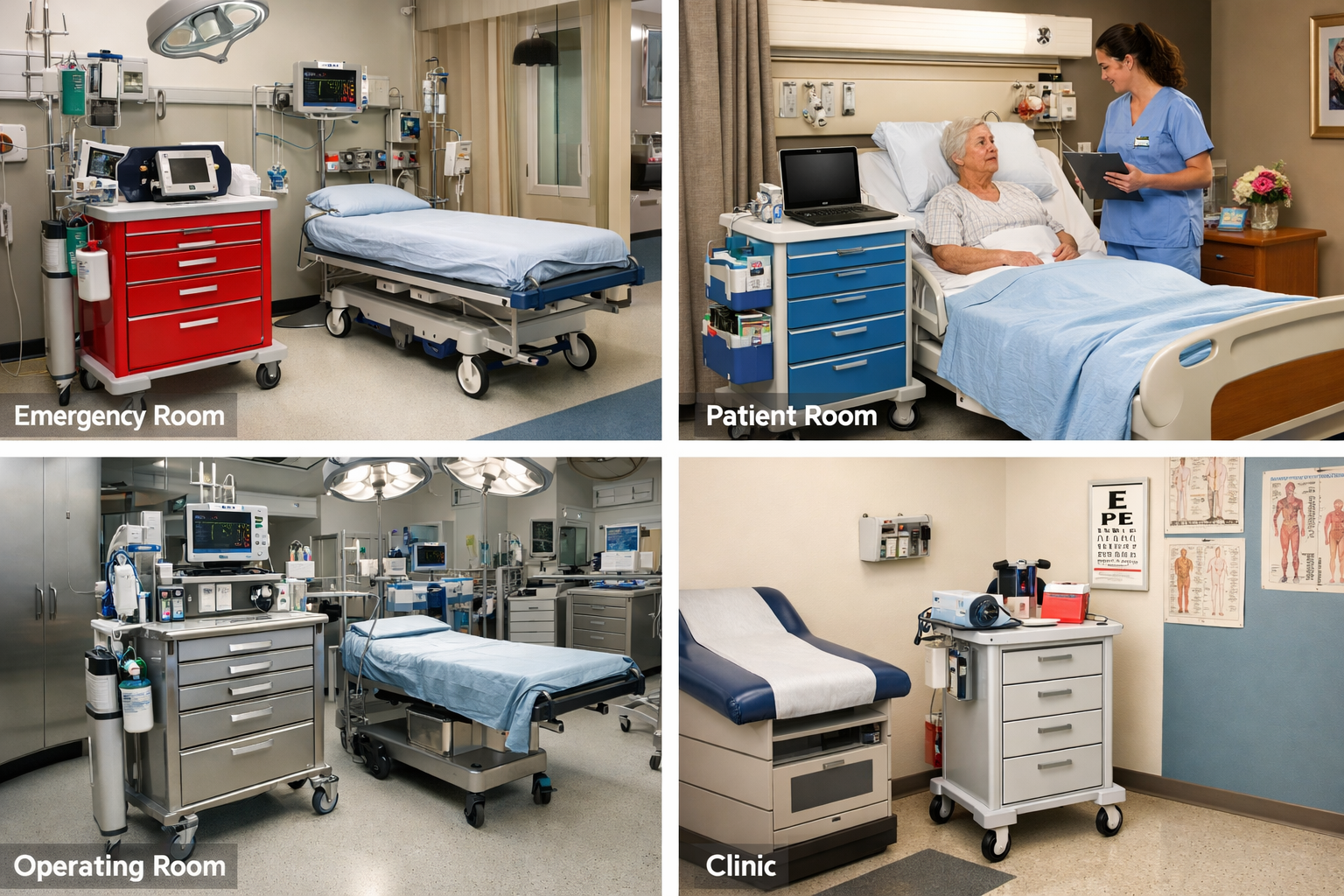
In the ED and OR, carts provide immediate access to protocols, imaging, and supply tracking during high-acuity situations where seconds matter.
Future Trends
The current point of care cart is already significantly more capable than its predecessors but the POCs continue to evolve. Several trends are shaping the next generation of mobile workstations:
- AI-assisted clinical decision support: Embedded AI engines will provide real-time alerts, suggested diagnoses, and screening flags directly on the cart display.
- Autonomous cart navigation: Carts that can autonomously travel between rooms, reducing transport burden on nursing staff in large facilities.
- Advanced antimicrobial surfaces: Next-generation carts will incorporate UV-C disinfection cycles and copper-infused or silver-ion-coated surfaces, reducing germ risks.
- IoT integration and asset tracking: Carts will continuously transmit location, inventory, and utilization data to facility management systems for maintenance and supply replenishment.
- Modular, role-specific configurations: Rather than one-size-fits-all designs, carts will be assembled from interchangeable modules specific for the diagnostician’s needs.